
 The markets just witnessed one of the largest IPOs in history. SpaceX priced its shares at $135, raised a record $75 billion, and saw its stock open higher before closing up nearly 19% on the first day of trading. Elon Musk briefly became the world’s first trillionaire on paper, and the company’s market capitalization quickly moved into the $2 trillion-plus range.
For many observers, it was exciting. For professional investors and fiduciaries, it was also a timely case study in how challenging it can be to value a fast-moving, capital-intensive business that is still heavily investing in its own future.
When a company goes public, particularly one with a transformative story, the first days of trading are often driven more by sentiment, media coverage, and momentum than by precise fundamentals. Prices can swing sharply in both directions as different groups of investors, some focused on long-term vision, others on short-term trading, find their footing.
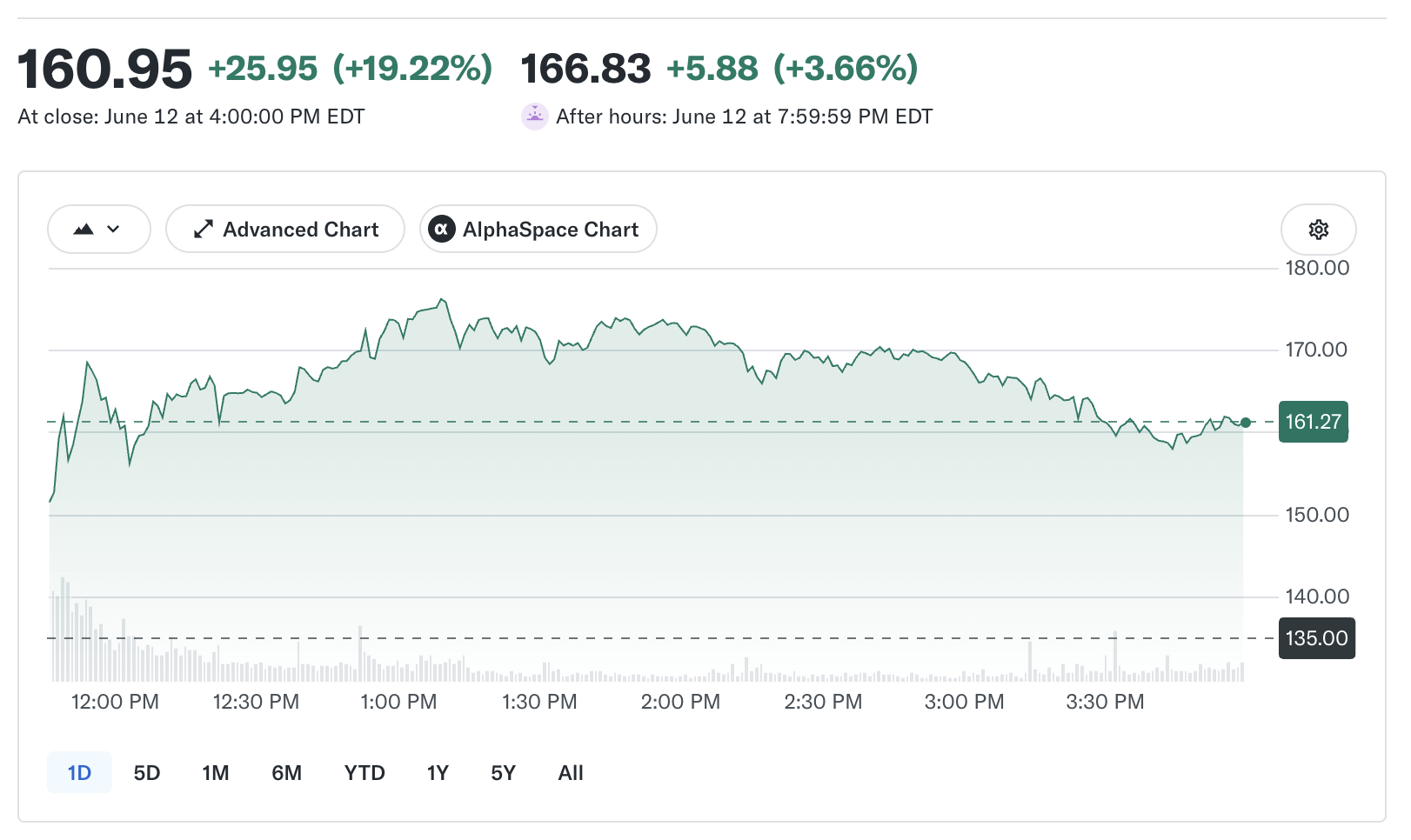
Around 1:09 PM, SPCX traded above $176/share. It closed near $161. Investors who bought stock in the early afternoon finished the day down 8.5% on their position, even though SPCX gained over 19% for the day. IPO stocks move fast. (Below chart provided by Yahoo.com)
SpaceX is a prime example of a business that is genuinely difficult to value with traditional tools. It operates in multiple high-growth but interdependent areas: reusable rocket launches, global satellite broadband, government/defense applications, and now large-scale AI computing infrastructure. Revenue is growing quickly, but the company is also spending aggressively on satellites, next-generation rockets, data centers, and related technology.
That spending shows up as operating losses and negative cash flow in the near term. Media headlines sometimes highlight those losses without the full context. The reality is that many high-growth companies in technology and infrastructure look “unprofitable” on a GAAP basis precisely because they are reinvesting heavily to build scalable platforms that can generate much larger revenues later.
This is not unique to SpaceX. Early Amazon and Tesla showed similar patterns during their heavy investment phases. The key question for any investor is whether that capital is being deployed effectively and whether the long-term economics justify the current valuation.
Rather than applying a simple earnings multiple (which would be meaningless or even misleading right now), a thorough analysis often looks at the business in segments and considers revenue growth trajectories, unit economics, competitive moats, and the total addressable markets being pursued.
Here’s a simplified framework based on publicly discussed perspectives:
SpaceX has already demonstrated reusable rocket technology at scale with Falcon 9, dramatically lowering the cost of reaching orbit. Starship represents the next major leap, a fully reusable system designed for much higher payload capacity and lower cost per kilogram. Success here could expand markets in satellite deployment, potential point-to-point Earth transport, and eventually deeper space missions.
This segment provides optionality. Even without perfect execution on every future goal, continued leadership in reliable, lower-cost launch services creates a durable advantage.
Starlink is currently the largest revenue contributor. The company has millions of subscribers and is expanding rapidly into maritime, aviation, enterprise, and government use cases. What makes the network particularly interesting is how the satellites communicate with each other.
Each Starlink satellite includes optical inter-satellite laser links capable of very high data rates. These connections allow the constellation to function as a true mesh network in low Earth orbit. Data can be routed between satellites in space rather than always having to go down to a ground station and back up. This architecture supports lower latency, better global coverage (including remote and oceanic areas), and greater resilience.
Proponents see Starlink evolving into critical global communications infrastructure, connecting underserved populations, supporting mobile applications, and potentially enabling direct-to-cell connectivity. Long-term revenue projections from bullish investors have included ambitious scenarios with hundreds of millions of users and very high average revenue per user, though actual results will depend on adoption, pricing, competition, and regulatory factors.
More recently, SpaceX has moved into large-scale AI computing capacity. The company has signed notable agreements to provide GPU and related compute resources to major players, including a reported $1.25 billion per month arrangement with Anthropic and a $920 million per month deal with Google (phasing in over time). Together these represent substantial contracted revenue visibility, on the order of $26 billion annualized once fully ramped.
These deals add a more predictable revenue stream tied to the explosive demand for AI training and inference capacity. Some long-term visions also include moving portions of data centers into space for potential advantages in power, cooling, or latency. Whether those materialize at scale remains to be seen, but the near-term terrestrial (or hybrid) compute business already provides tangible revenue support for the overall valuation narrative.
Prominent long-term investor Ron Baron, who has held SpaceX shares since the private-company days, has expressed a highly bullish multi-year view. He has pointed to Starlink’s potential to serve a massive global user base, combined with Starship-enabled scale and space-based data center opportunities, as drivers that could take the company’s value dramatically higher over a decade or more, into the $10–30 trillion range in optimistic scenarios. His conviction stems from watching the company execute on reusability and satellite deployment for years.
Other sophisticated observers, such as Chamath Palihapitiya around the time of the IPO, framed a case for the ~$2 trillion valuation range using forward revenue multiples (around 20x on projected sales). They anchored much of the value in the connectivity and infrastructure buildout, treating launch services, defense work, and future orbital compute as additional upside. Revenue was described as ramping from roughly $18–19 billion in 2025 toward $25–30 billion or more in the near term, with much larger long-term potential if data center and AI infrastructure scale as hoped.
These are not precise forecasts, they are informed views based on different assumptions about growth rates, margins, timelines, and competitive dynamics. Small changes in those assumptions can produce very different valuation outcomes. That is exactly why deep, segment-by-segment analysis is required.
SpaceX’s IPO filings also disclosed an enormous long-term total addressable market vision spanning connectivity, space-enabled solutions, and AI infrastructure, numbers in the tens of trillions. Those are aspirational and depend on successful execution across many fronts. They illustrate the scale of the opportunity that excites some investors while also highlighting how much has to go right.
In my work as an independent fiduciary advisor here in Commack, I regularly perform this kind of detailed fundamental research when evaluating individual stocks for client portfolios. That includes reviewing filings, modeling different scenarios, assessing execution risks and competitive moats, and stress-testing valuations. It’s time-intensive work.
At the same time, I am very clear with clients that individual stocks, especially complex, high-growth names like this, are not appropriate for every portfolio or every life stage. Many Long Island retirees, pre-retirees, police officers, and civil servants I work with are best served by a core allocation to low-cost, broadly diversified index ETFs. These provide market exposure without concentrating risk in any single company’s execution or valuation assumptions.
We can then consider adding selective individual positions only when they fit the client’s overall risk tolerance, time horizon, liquidity needs, tax situation, and existing assets. Everyone’s circumstances are different. What feels like an exciting growth opportunity to one person can represent unacceptable volatility or concentration risk to another.
The SpaceX IPO offers a vivid reminder that headline numbers, whether a first-day pop or a quarterly loss, rarely tell the full story. Professional valuation of a company like this requires looking through the reinvestment phase to the underlying revenue drivers, network effects (such as Starlink’s space mesh), contracted cash flows from major deals, and the probability-weighted outcomes of major technical milestones.
If an investor is not prepared to do (or have done on their behalf) that level of analysis, it’s often wiser to stick with diversified, low-cost index strategies rather than trying to own individual high-profile growth stocks directly, especially in the volatile period right after an IPO.
That is the approach I take with clients every day: rigorous research where it adds value, broad diversification as the foundation, transparent low fees (0.50% AUM), and recommendations tailored to each person’s real-life situation rather than market hype.
Markets will continue to present interesting opportunities and complex valuation questions. The investors who do best over time are usually the ones who understand what they own and why it fits their broader plan.
Chris Wargas is the founder of First Shelbourne, a Registered Investment Advisory firm based in Commack, New York.
The information on this site is for educational and informational purposes only and should not be interpreted as personalized investment, tax, or legal advice. Nothing presented constitutes a recommendation to buy or sell any security, or to implement any specific strategy. Investment decisions should be made based on an individual’s unique financial situation, objectives, and risk tolerance.
All investments involve risk, including the potential loss of principal. Past performance is not indicative of future results. Any references to specific securities, mutual funds, or investment strategies are for illustrative purposes only and may not be suitable for all investors.
The views expressed are those of the author as of the date indicated and may change without notice. While care has been taken to ensure the accuracy of the information provided, no representation or warranty is made as to its completeness or reliability.
Readers should consult with a qualified financial professional and, where appropriate, a tax or legal advisor before making any financial decisions. Advisory services are offered through First Shelbourne, a Registered Investment Adviser.