
You worked a full career, put in the hours, and diligently built up a substantial 401(k) or 457(b) nest egg. Now, retirement is finally here. The big question standard financial planning often fails to answer clearly is simple: how do you prevent that account from draining to zero over the next 20 to 30 years?
I’m Chris Wargas, founder and CCO of First Shelbourne LLC in Commack, New York. As a retired New York police officer who completed 20 years before launching my second career in wealth management, I speak with retiring officers, business owners, and hard-working families every single day.
Too often, retirees are immediately pitched high-fee annuities or complex life insurance policies they simply do not need, especially if they already have a solid pension floor. On the flip side, many are told by well-meaning friends to dump everything into a broad S&P 500 index fund and set it on autopilot.
Both approaches overlook a critical financial danger: sequence of returns risk.
When you are in the accumulation phase of your career, portfolio volatility is manageable. If the market drops 20%, you continue working, buy shares at a discount, and let compounding do its work over time.
Once you retire and start taking distributions, the math completely changes. Below, we can see a chart of when you are in the acumulation phase and adding money to a retirement account. The sequence in which the market gains in value each year, or loses value, doesn’t make a difference regarding what the ending account value will be.
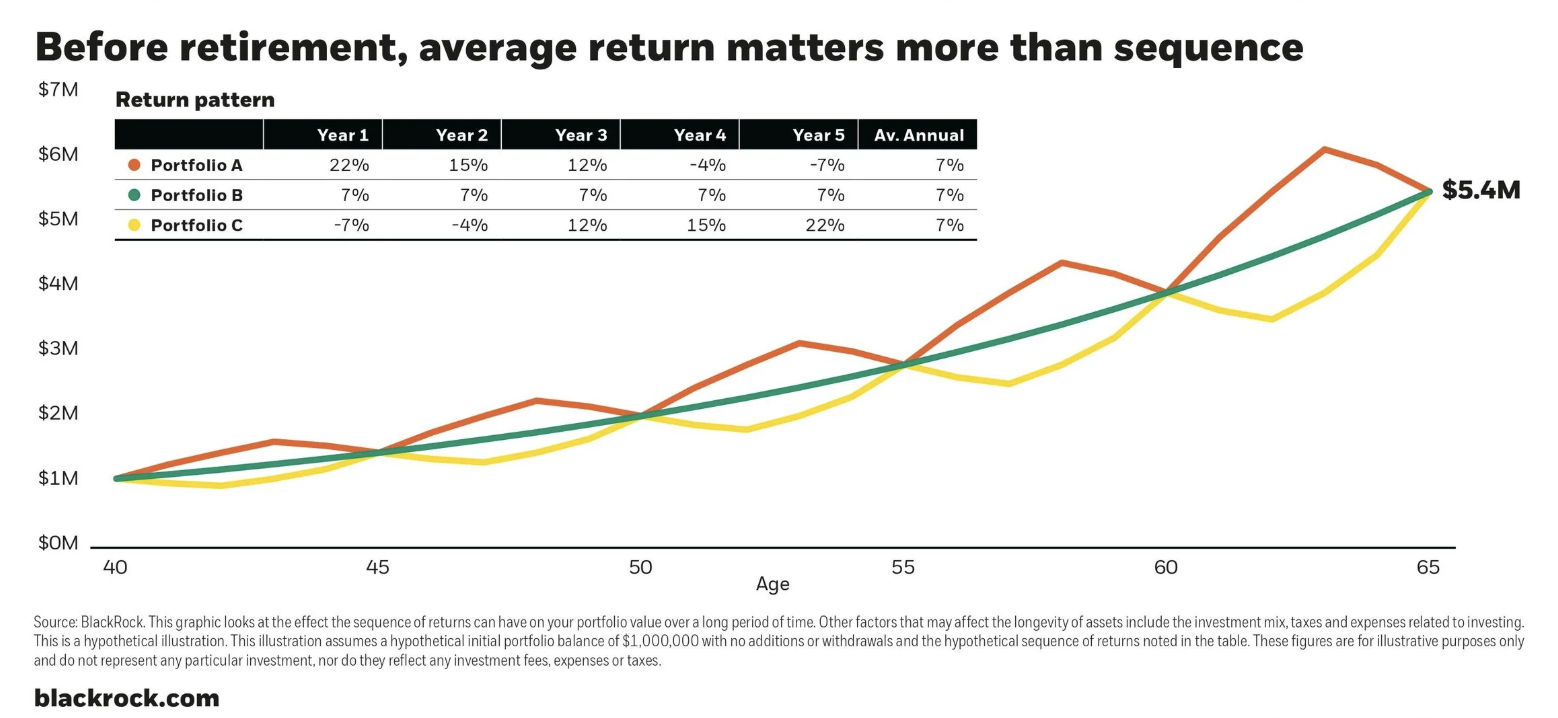
Sequence of returns risk refers to the order in which market returns occur. Two retirees can experience the exact same average annual return over a 25-year period, but if one person experiences sharp market declines during the first few years of retirement while taking withdrawals, their portfolio can be completely wiped out decades earlier.
Now, let’s look at a chart of withdrawing money instead of adding. You can see below that the sequence in which the market generates its return matters much more.
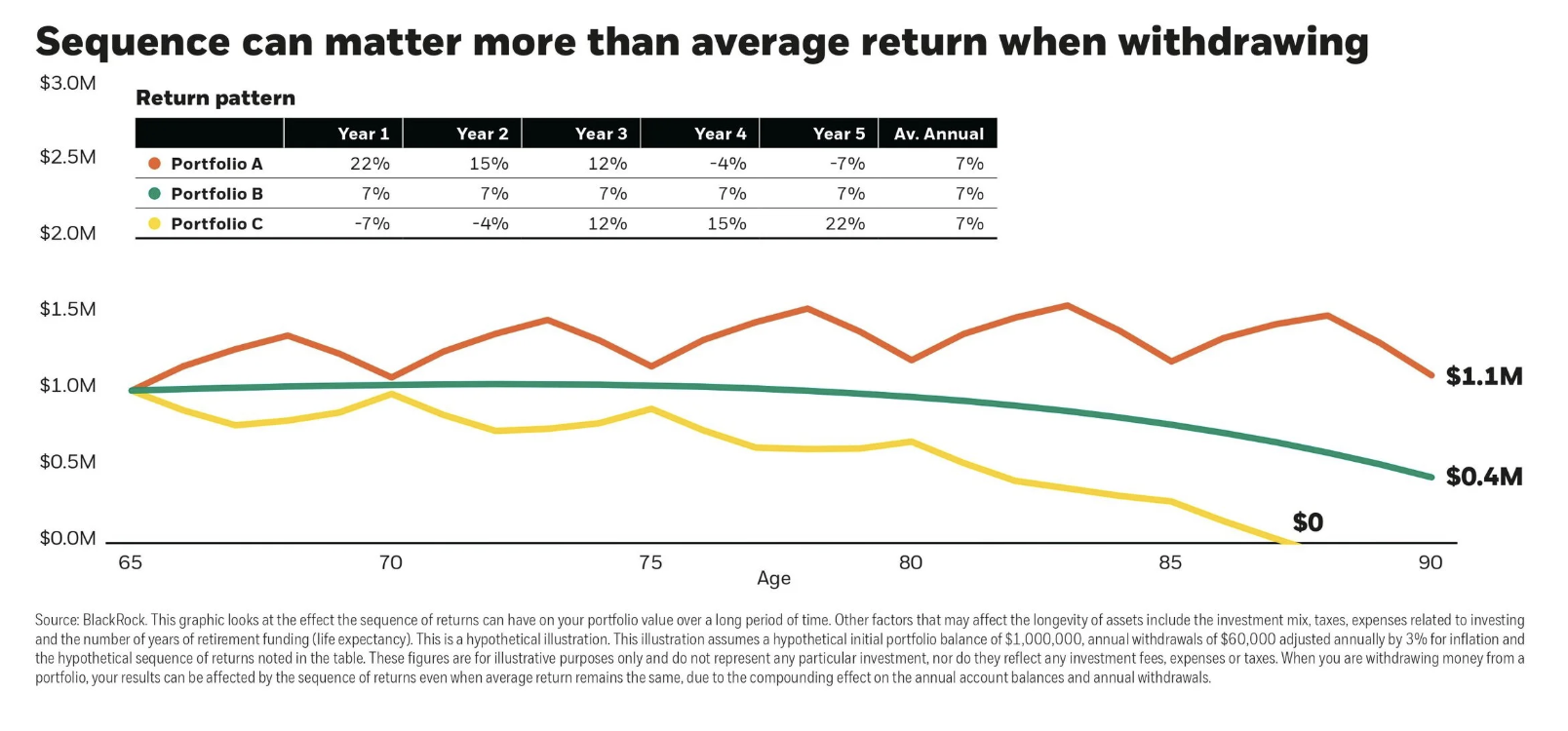
If you are forced to sell equities in a down market to satisfy personal living expenses or Required Minimum Distributions (RMDs), you lock in those losses permanently. Your capital base shrinks, making it mathematically impossible for the remaining balance to recover even when the market rebounds later.
A common piece of advice circulating in breakrooms is that having a pension means you can take endless risk with your 401(k) or 457(b) plan. People assume their pension acts as a total cushion, allowing them to remain 100% invested in equities.
In reality, most investors overestimate their true risk tolerance. It’s easy to say you are comfortable with aggressive growth when the market is moving higher. The moment a market correction hits and account balances drop precipitously, panic sets in. Selling at the bottom during a market drop creates a permanent impairment of capital.
A pension gives you an incredible base, but your tax-deferred savings should act as a reliable, lower-volatility engine that supplements your pension, not a speculative trading account.
Protecting your portfolio does not mean hiding cash under the mattress. It means structuring a diversified fixed income portfolio that produces reliable income without exposing you to unnecessary stock market drawdowns. I still use many stock index ETFs in the portfolios I contstruct, but I take a more conservative approach.
Unlike the near-zero interest rate environment of the past decade, today’s fixed income landscape offers meaningful yields:
By constructing a dedicated bond ladder and dividend-yielding allocation, you can draw your required retirement income directly from fixed income yields and distributions, leaving your core equity holdings untouched during market downturns.
While employer-sponsored 401(k) and 457(b) plans are useful accumulation tools during your working years, they often present limitations when you transition into distribution mode:
Rolling over your institutional 401(k) or 457(b) into a standalone Traditional IRA opens access to the entire investable universe. It enables your advisor to construct an individualized portfolio designed specifically around your distribution timeline, tax bracket, and long-term legacy goals.
At First Shelbourne, my approach centers on peer-to-peer trust, clear communication, and straightforward pricing. You should never leave a meeting with an investment advisor feeling confused or pressured into buying complex insurance contracts or products with hidden commissions.
I operate under a clear fee-only model:
Your retirement competition is not the day-trader down the street trying to chase tech stocks, it is simply ensuring your personal financial plan preserves your wealth and gives you total peace of mind.
Sequence of returns risk is the risk that the timing of market downturns will negatively impact the overall longevity of your retirement portfolio. Experiencing negative returns during the early years of withdrawing funds permanently reduces your principal, increasing the likelihood that your account will run out of money prematurely.
For many retirees, rolling over employer plan funds into an IRA provides greater investment choice and the ability to build custom fixed income strategies tailored to your income needs, so you should review your plan details with a fiduciary advisor before moving funds.
While an S&P 500 index fund has historically delivered strong long-term growth, it experiences significant volatility. If a severe market drop occurs right as you begin taking regular living distributions or Required Minimum Distributions (RMDs), selling stocks at depressed prices can permanently damage your portfolio balance.
Chris Wargas is the Founder, Chief Compliance Officer, and Investment Adviser Representative at First Shelbourne LLC, an independent Registered Investment Advisory firm based in Commack, New York. A retired New York police officer with 20 years of public service, Chris specializes in low-volatility portfolio management, pension-supplement planning, and fee-transparent wealth strategies for retired first responders, business owners, and families across Long Island.
The information on this site is for educational and informational purposes only and should not be interpreted as personalized investment, tax, or legal advice. Nothing presented constitutes a recommendation to buy or sell any security, or to implement any specific strategy. Investment decisions should be made based on an individual’s unique financial situation, objectives, and risk tolerance.
All investments involve risk, including the potential loss of principal. Past performance is not indicative of future results. Any references to specific securities, mutual funds, or investment strategies are for illustrative purposes only and may not be suitable for all investors.
The views expressed are those of the author as of the date indicated and may change without notice. While care has been taken to ensure the accuracy of the information provided, no representation or warranty is made as to its completeness or reliability.
Readers should consult with a qualified financial professional and, where appropriate, a tax or legal advisor before making any financial decisions.
Advisory services are offered through First Shelbourne, a Registered Investment Adviser.