
Every so often, I’ll review an investment statement for a new client here at my office in Commack Long Island and see a portfolio packed with mutual funds charging close to 1% per year in internal expenses. The client will say, “Chris, I don’t even know what fees I’m paying. I can’t understand any of this stuff.” Then we dig into the fund costs, and they realize there’s a whole second layer quietly coming out of their returns.
That second layer doesn’t show up as a line item on your statement. It doesn’t say “extra fee” in bold. It’s buried inside the mutual fund itself, and the way you experience it is simple: it’s growth you should have had but never see.
How High‑Fee Mutual Funds Hide in Plain Sight
When most people think of investment fees, they look at the advisory fee, the percentage charged on assets under management. Many Long Island retirees and business owners will say, “I’m paying 1% to my advisor, that’s the cost.” What often gets missed is that the mutual funds themselves also have expense ratios, and those can be surprisingly high.
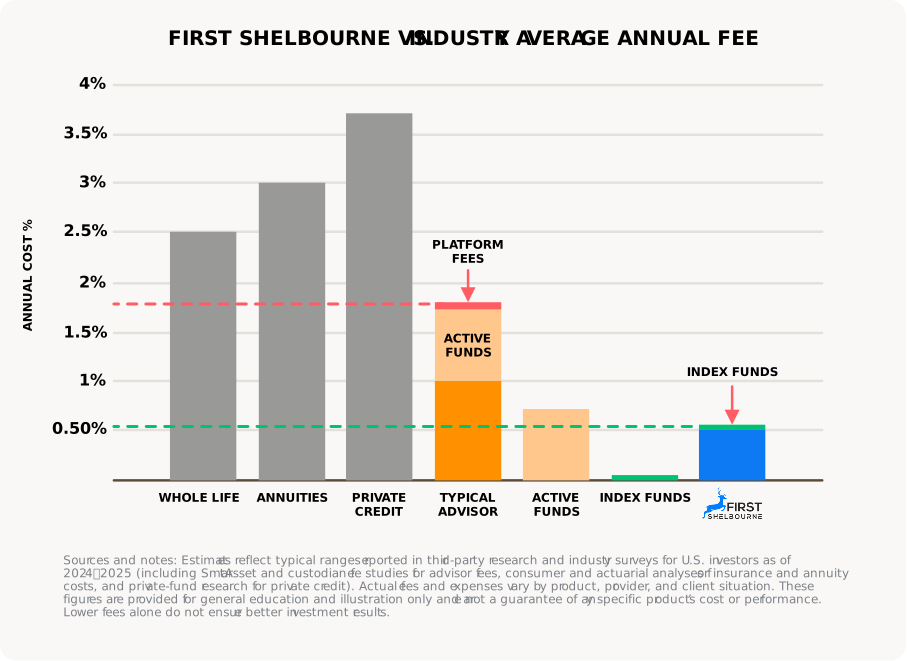
If a fund charges, for example, 1.25% in expenses every year, that cost is built into the fund’s performance. You don’t see a separate debit leaving your account. Instead, your returns are simply 1.25% lower (on average, over time) than they would be if that same portfolio were run at almost no cost. It’s not a bill; it’s a drag.
That’s why these costs feel “invisible.” No one sends you an invoice for them. Instead, they quietly reduce your returns every single year. Over a 25–30 year retirement, even a 0.50–1.00% annual difference can add up to a very large amount of money that ends up with the fund company and its corporate parent instead of supporting your life on Long Island.
Why Some Advisors Still Use Expensive Funds
If low‑cost index funds and ETFs exist, why are so many portfolios still filled with high‑fee mutual funds, especially at big-name firms with large corporate parents? The honest answer is that, in many cases, the structure is built to favor the firm first, not the client.
Some corporate environments heavily promote in‑house funds or “preferred” funds that pay higher internal compensation, revenue sharing, or other benefits back to the firm. The advisor may have a limited menu or a strong incentive, explicit or subtle, to use those products. On paper, the advisor might say, “You’re not paying me more than 1%,” but the overall cost to the client, once you factor in fund expenses, can be much higher.
This is where the conflict of interest lives. An advisor who’s required, nudged, or rewarded for using higher‑fee products that benefit the corporate parent is not truly free to choose the lowest‑cost, most efficient tools available for the client. From a client’s perspective, that’s a quiet form of betrayal: the person you think is putting you first is actually operating in a system where your best interest is often secondary.
Most individuals who transfer their assets to my firm are usually coming from nationally recognized name-brand firms. When I look through their statements, I’m usually horrified at what I see. It’s usually the same story. The portfolio doesn’t hold any low-cost index ETFs or low-cost index mutual funds, but instead is full of an array of high-fee mutual funds, all with overlapping assets.
The Real Cost: Returns You Never See
The hardest part for investors is that the damage doesn’t feel immediate. If markets are rising, your account balance still goes up, so it’s easy to assume everything is fine. But imagine two portfolios holding the same investments before fees. One costs about 0.55% per year because the investor works with a truly independent advisor who uses low‑cost index funds (this is what I do). The other costs around 2.2% per year once you add a typical advisor fee of 1%–1.25%, higher fund expenses, and hidden platform charges.
In the first year, the difference might not feel huge. Over 10, 20, or 30 years, that gap can compound into tens or even hundreds of thousands of dollars that never make it into your pocket. You don’t see a line item that says, “Here’s what you could have had.” You just end up with less, and most investors never realize how much of that shortfall was avoidable.
That’s what I mean when I say high‑fee funds are a hidden fee. They show up in the form of lower balances when you need them most: in your 60s, 70s, and 80s, when it’s harder to go back and earn that money again.
What a Fiduciary Approach Looks Like in Practice
From a fiduciary standpoint, the starting point is simple: if a lower-cost, well‑diversified fund can do the same job as a higher‑fee fund, the lower-cost option should be the default (data shows that low-cost index funds outperform actively managed funds over 5, 10, 15, 20, and 30 years). Many retirees in Commack and across Long Island find that a mix of low‑cost index funds and ETFs can build a solid, diversified portfolio without layering on unnecessary expenses.
That doesn’t mean every higher‑cost fund is automatically “bad” or that there aren’t specialized strategies that justify a somewhat higher fee. But the burden of proof should be on the strategy, not on the client’s trust. An advisor should be able to clearly explain why a more expensive fund is being used, what value it’s expected to add, and why there isn’t a more cost‑effective alternative.
If you ask an advisor, “Why are we using this fund that costs over 1% when there’s a similar fund at a fraction of that cost?” and the answer sounds vague, defensive, or leans heavily on corporate talking points, that’s a red flag. It may be a sign that the advisor is serving two masters, you and the firm’s bottom line, and the firm is winning.
Client Betrayal in the Real World
The tough reality is that this kind of misalignment is everywhere. It’s in 401(k) lineups packed with pricey funds when cheaper options exist. It’s in retail portfolios at big-name firms filled with proprietary mutual funds. It’s in “managed solutions” that sound sophisticated but are really just another layer of fees on top of what you already pay.
From where I sit, reviewing portfolios for retired police officers, teachers, railroad workers, and Long Island business owners, it doesn’t look like this trend is calming down. If anything, the fee structures just get more complicated, making it harder for the average investor to see what they’re truly paying.
That’s why asking blunt questions about cost, alternatives, and conflicts of interest is so important. You don’t need to become a fee expert, but you do deserve an advisor who’s willing to walk you through how they get paid, how the funds get paid, and why each piece of your portfolio is there.
What Investors on Long Island can do
For many people, a good first step is simply to gather your statements and look up the expense ratios of the funds you own. If you see multiple funds charging 0.80%, 1.00%, it’s worth asking why those specific funds were chosen. Then, compare that total cost — advisory fee plus average fund expenses — to what a lower-cost, diversified approach might look like. If you are unsure, email me and I will do it for you.
An Investment Advisor operating under a fiduciary standard should be comfortable having that conversation and, if appropriate, helping you transition away from unnecessary high‑fee products over time. The goal isn’t to chase the cheapest thing blindly; it’s to avoid paying more than you need to for the same level of diversification and risk.
At the end of the day, it’s your money, your retirement, and your life. The tools used in your portfolio should be selected with that in mind, not to quietly feed a corporate parent you’ve never met.
About the author
Chris Wargas is the founder of First Shelbourne, a Registered Investment Advisory firm based in Commack, New York. He is also a retired police officer, which gives him firsthand perspective on the retirement questions many NYPD, Suffolk County, and Nassau County officers face when evaluating pensions, deferred compensation plans, IRAs, and rollover options.
Disclaimer
The information on this site is for educational and informational purposes only and should not be interpreted as personalized investment, tax, or legal advice. Nothing presented constitutes a recommendation to buy or sell any security, or to implement any specific strategy. Investment decisions should be made based on an individual’s unique financial situation, objectives, and risk tolerance.
All investments involve risk, including the potential loss of principal. Past performance is not indicative of future results. Any references to specific securities, mutual funds, or investment strategies are for illustrative purposes only and may not be suitable for all investors.
The views expressed are those of the author as of the date indicated and may change without notice. While care has been taken to ensure the accuracy of the information provided, no representation or warranty is made as to its completeness or reliability.
Readers should consult with a qualified financial professional and, where appropriate, a tax or legal advisor before making any financial decisions.
Advisory services are offered through First Shelbourne, a Registered Investment Adviser.